Why does polyester start to smell and why is old sweat odor so hard to remove?
The garment is freshly washed and smells clean, but after a while on the body, the old sweat odor returns. This often happens with workout clothes, but it is far from limited to them. It could be polyester tops that quickly start to smell under the arms, blouses that feel unrefined sooner than they should, or blazers that are clean but where the polyester lining starts to smell as soon as it warms up against the body.
This phenomenon is sometimes called permastink. The explanation is more complex than old sweat simply remaining in the garment. The material interacts with skin oils, sweat, and other organic residues, microorganisms, moisture, and temperature. Furthermore, we who wear the garment also play a role.
A broader explanation exists if we view the textile as a small microbial ecosystem, where all these factors influence one another.
Why does polyester start to smell of sweat?
Fresh sweat smells relatively little. The typical sweat odor arises primarily when microorganisms break down substances from sweat, skin oils, and other secretions, forming compounds that we perceive as odor.
When a garment lies against the skin, sweat, skin oils, skin cells, and bacteria and other microorganisms transfer to the textile. There, they encounter a material with its own specific properties. Add moisture, heat, and time, and you have an environment where odor can develop.
Polyester is particularly interesting. The material is hydrophobic, which simply put means that it does not attract and bind water the same way cotton does. However, polyester is more prone to absorbing oils and other fat-soluble substances. In a study of cotton and polyester, researchers observed that skin oils were distributed along the polyester fibers and between them. They also observed that more bacteria attached to polyester than to cotton.
It is therefore too simple to say that the sweat has "gotten stuck in the polyester." What happens is an interaction between material, organic residues, microorganisms, moisture, temperature, and the individual.
The textile as a microbial ecosystem
Different materials create different conditions for microorganisms. In a study where 26 people exercised in, among other things, polyester and cotton, the polyester garments smelled both stronger and less pleasant afterward. The researchers also observed differences in which microorganisms established themselves on the materials.
At the same time, the material is only one part of the system. We humans have different microbiomes on our skin and produce different amounts and compositions of sweat, skin oils, and other secretions. In a study of worn cotton and polyester shirts, researchers observed that the individual wearing the garment influenced the textile's microbiome more than both the material and the wash.
Even genetic variations can influence which substances the body secretes and thus the conditions for body odor. This does not mean that our genes determine how a garment will smell, but they are an additional factor in a system that is more individual than one might first think.
The same polyester top can therefore develop odors in different ways depending on the person.
Why polyester can easily develop sweat odor
Polyester has different surface properties than, for example, cotton and more easily absorbs oils and other fat-soluble substances from the body. At the same time, a used textile can be seen as a small microbial ecosystem, where the material interacts with organic residues, microorganisms, moisture, temperature, and the person wearing the garment. This helps explain both why polyester can easily develop an odor and why old odors can be difficult to remove after many uses and washes.
Why does polyester still smell after washing?
This is where we arrive at what is sometimes called permastink. The garment comes out of the wash smelling clean, but when you put it on and the material becomes warm and damp, the old odor quickly returns.
One explanation is that the wash has not removed everything that remains in the textile. Organic residues, microorganisms, and certain odor compounds can remain even after washing. Research into repeated soiling and wash cycles also shows that some odor compounds can be harder to remove from polyester than from cotton, and that odor compounds can accumulate over several cycles.
When the garment is back on the body, the environment changes again. Heat and moisture are added along with new organic residues and microorganisms from the skin. This can contribute to a garment that smells clean when dry quickly beginning to smell of old sweat again.
The garment's history also plays a role. A garment that has only recently started to smell does not have the same starting point as a polyester top, a blazer lining, or a workout shirt that has been used and washed many times. Repeated cycles of use, drying, and washing can make the odor problem significantly more complex.
Textile odor is therefore not a single substance to be neutralized. It is the result of a biological and material-technical system that has developed over time.
How do you get sweat odor out of polyester?
Here we begin at the same end as always at Pure Effect:
Odor is not the problem. The problem is the organic residues that odor-producing bacteria feed on.
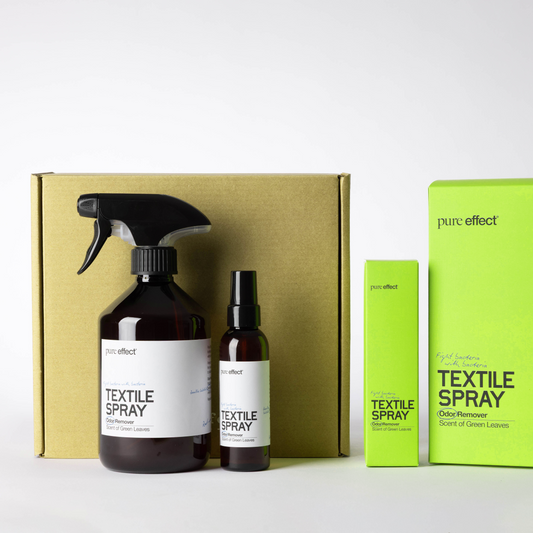
Pure Effect Textile Spray contains selected spores of Bacillus subtilis and is based on biotechnology. When the conditions are right, biological processes help to break down organic residues that odor-producing bacteria could otherwise feed on.
Textile Spray therefore works with the conditions behind the odor rather than just masking it with perfume. It could be for workout clothes after a run, but equally for the polyester top you want to wear again, the dress that doesn't need to be washed, or the blazer where the lining has started to smell. Spray. Wait. Use again.
What do you do with really ingrained sweat odor?
With old and ingrained odors, more time may be needed. Ideally, start with a clean and dry garment and treat, in particular, the area where the odor is located, for example under the arms, across the back, around the collar, or in a blazer lining. Then give the Textile Spray time to work and let the garment dry thoroughly.
With really stubborn odors, the treatment may need to be repeated. More product at once is not necessarily better. Time and repetition can be more important. An older polyester garment with many years of use and washing behind it may simply have significantly more difficult conditions than a garment where the odor problem has just begun.
Sometimes we cannot remove all the odor. Textile Spray cannot be expected to provide the same result on all materials and garments because the starting point can be so different. This is also an important part of understanding permastink. When an odor problem has built up over a long time, it can be significantly more difficult to solve than treating the odor early.
Prevent sweat odor before it sets in
The best approach is therefore not to wait until your favorite garment has developed a really difficult case of permastink. Let damp garments dry thoroughly, address odor when it arises, and distinguish between odor and dirt.
A garment that smells does not automatically need a full wash. Sometimes it needs to be aired out, sometimes the odor needs to be treated, and sometimes, of course, it needs to be washed. Making that assessment between uses and washes is especially valuable for blazers, dresses, and other delicate or difficult-to-wash garments that we neither can nor want to wash after every use.
By addressing odor early, we can help the garment stay fresh between washes and keep it in use longer. Use more, and wash less.
FAQ - Frequently asked questions about sweat odor in polyester
Why does polyester smell more of sweat than cotton?
Polyester has different surface properties than cotton. The material absorbs oils and other fat-soluble substances more easily and also influences how microorganisms attach and behave in the textile. Together, these can create conditions for odors to develop and become harder to remove.
Why do clothes smell of sweat immediately after washing?
The wash may not have removed all organic residues, microorganisms, and odor substances. When the garment then becomes warm and damp against the body, the environment in the textile changes again, and the odor can quickly become noticeable.
Does permastink only apply to workout clothes?
No. Workout clothes are a clear example because they are exposed to a lot of sweat, heat, and moisture, but the same problem can arise in, for example, polyester tops, blouses, dresses, and polyester linings in blazers.
Why does the same polyester garment smell different on different people?
We have different skin microbiomes and different compositions of sweat, skin oils, and other secretions. Research on worn T-shirts shows that the individual can have a major impact on the textile's microbiome. Genetic factors can also influence the conditions for body odor.
Can you get old sweat odor out of polyester?
Often it is possible to reduce or remove the odor, but the result depends on the material and the garment's history. With old and ingrained odor, the treatment may need to be repeated, and sometimes not all the odor can be removed.
Related reading
What is dry cleaning and when is it needed?
What methods are there for removing odor, and how do they differ?