What methods are there for removing odors – and what differentiates them?
Removing odors from clothes may seem simple: wash, air out, or spray something nice-smelling. Sometimes it works, but often the odor returns. And we pause at that moment, just when holding a garment and hesitating to put it in the wash, there's a more fundamental question to ask:
What exactly is smelling – and what does it take to truly get rid of it?
Because once you start with the root cause, it quickly becomes clear that most methods we use are not designed to solve the problem. They are designed to manage the symptoms. And that is a crucial difference.
In this post, we will cover:
- What actually causes bad odors in clothes and items
- Why common methods only work temporarily
- What it takes to truly remove odors
What causes bad odors in clothes, shoes, and equipment?
It's easy to assume that sweat is what smells. But fresh sweat is largely odorless. What happens instead is that sweat - along with organic matter such as skin cells, sebum, and other bodily residues - remains in the textile fibers after use.
There, in an oxygen-deprived microenvironment within the textile, bacteria begin to break down the organic material. This is called anaerobic decomposition, and it is precisely this process that creates the molecules we perceive as bad odor. This means that odor is not something that "sits on top" of the garment. It is the result of an ongoing process inside the material.
Why doesn't the odor disappear permanently?
Most methods we use do one thing: they interrupt the process – temporarily. But they don't change why the odor occurs.
Common odor removal methods (and why they aren't always enough)
1. Washing
Removing odors by washing relies on rinsing away what is in the garment. This reduces the amount of bacteria and organic material, and therefore also the odor. But it doesn't change which bacteria establish themselves there. The same type of microbial environment arises again, and the process restarts. (And often we overshoot the mark – it's just a slight odor, but we solve it with a full wash, even though it unnecessarily wears on the garment and requires more resources than truly needed.)
2. Antibacterial products
Removing odors with antibacterial products containing biocides, such as silver, is based on trying to kill bacteria. The effect can be immediate and clear, but often short-lived – and in some cases can backfire with even more odor as a result. What survives is, in fact, more resistant. When bacteria return, the balance is often altered, and certain – sometimes odor-producing – bacteria can gain more space than before.
3. Vinegar, soap, and other pH methods
Removing odor by changing the pH with, for example, soap or vinegar, is done by creating a temporarily inhospitable environment due to the altered pH value. The odor-producing bacteria therefore have a harder time surviving. But when conditions return to normal, so do the bacteria. The disadvantage is that repeated use can affect and eventually break down the material's fibers.
4. Perfume and linen water
One of the most common ways to deal with odor is with perfumes and linen water. But fundamentally, it does one thing: it masks by adding a scent on top. The garment smells of something else – but the problem remains. The process that creates the odor continues beneath the surface, and when the masking scent disappears, the odor is still there.
The common thread is that most methods do not change the system that causes the odor. They mask or disrupt the process, but only temporarily.
Is there a way to actually remove odor?
Yes, but it requires a different approach. Instead of completely killing all bacteria, or hiding the smell, one can change the bacterial system in the garment.
Bacteria-based odor removal – how does it work?
If one instead starts from what actually causes odor, a different logic emerges. If certain bacteria create odor through how they break down organic material, one could introduce other bacteria that do the same – but without creating odor.
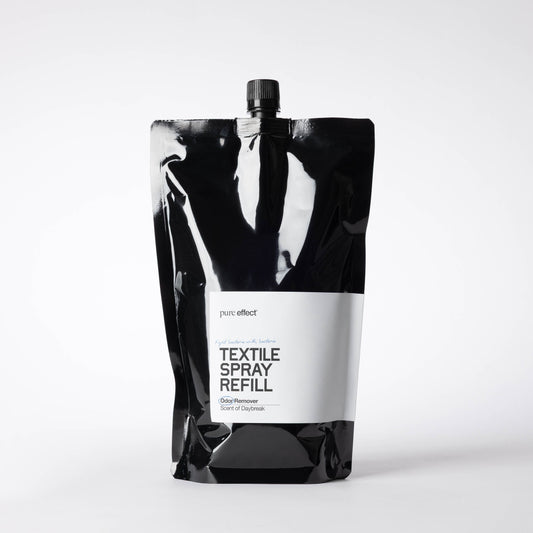
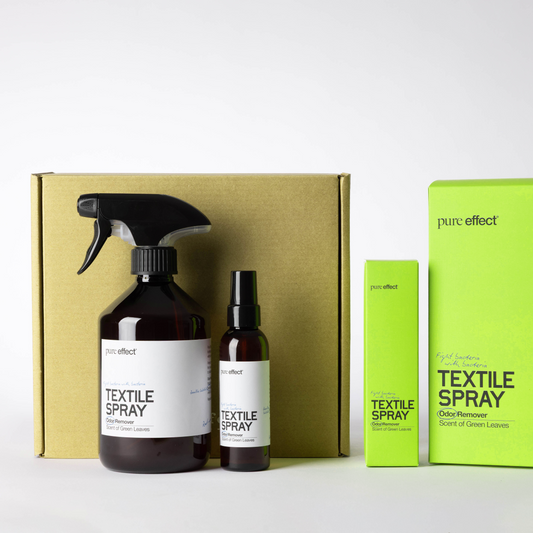
This is where a bacteria-based method, such as in Pure Effects Textile Spray, differs from other solutions.
Instead of trying to eliminate all life in the textile, "good" bacteria are added that compete with the existing flora. When they establish themselves, the decomposition itself in the material changes, from anaerobic to aerobic (from oxygen-deprived to oxygen-based) decomposition. And when the anaerobic process is not given space, there is nothing that creates odor. It is not a surface effect, but a change in conditions.
Why the effect changes over time
An important difference with this approach is that the effect is not always immediate, as with perfume or antibacterial treatments. Instead, it builds up stronger over time – it is cumulative. Each treatment slightly alters the microbial environment, making it harder for odor-producing processes to take hold – and resulting in less odor over time.
This is also evident in practical use. In field tests conducted with Wargön Innovation, the perceived effect increased over time – from 68% in the first week to 89% after four weeks. At the same time, the tests showed that participants actually washed less during the period, not as an ambition, but as a concrete behavioral outcome. For many, the spray became a new step before washing. Together, this points to something more than a temporary effect: a solution that changes how garments are used between washes. Read more about the Wargö tests here.
What does this mean in everyday life?
In practice, it's not about replacing washing, but about creating a new intermediary stage. A way to handle garments and textile items that are not dirty, but that smell or feel stale.
This applies especially to things that are difficult or impossible to wash at all – such as shoes, leather, suede, or sports equipment. When washing is not an option, this becomes a way to actually continue using something.
It breaks the automatic link between use and washing, and introduces a step in between. That's where the difference begins to show. Not as a single effect, but as a changed behavior – which means garments and textile items are used longer, washed less often, and wear out less.
A quick comparison of different odor removal methods

Most methods try to remove odor.
We have chosen to change why it arises. Discover how our Textile Spray works – and what happens when you let bacteria do the job.